Ghana's PAYE bands changed on 1 September 2026. See the new monthly bands, why the same salary now gets a different PAYE, and what to check before the 15 October return.

GRA's implementation notice confirms that the Income Tax (Amendment) Act, 2026 (Act 1178) changed the resident PAYE bands from 1 September 2026. Review September deductions before the return due on or before 15 October. For earlier periods paid after the change, ask your accountant which tax rule date applies; the payroll period alone does not settle a transitional case.
The new monthly PAYE bands
The monthly tax-free band rose from GHS 490 to GHS 588, while the 5%, 10% and 17.5% bands became narrower. The 25% band keeps the same width, and the top rate of 35% now starts at GHS 50,000 a month instead of GHS 50,416.67.
| Chargeable income per month (GHS) | Rate | Before 1 September 2026 |
|---|---|---|
| First 588 | 0% | First 490 |
| Next 80 | 5% | Next 110 |
| Next 100 | 10% | Next 130 |
| Next 2,900 | 17.5% | Next 3,166.67 |
| Next 16,000 | 25% | Next 16,000 |
| Next 30,332 | 30% | Next 30,520 |
| Above 50,000 | 35% | Above 50,416.67 |
On an annual basis, the tax-free band is now GHS 7,056 (previously GHS 5,880). GRA publishes the full monthly and annual tables on its PAYE page.
Why the same salary now gets a different PAYE
A higher tax-free band lowers PAYE, while narrower middle bands raise it. Which effect wins depends on the employee's chargeable income:
- Up to GHS 490 of chargeable income a month, both schedules give zero PAYE. Above that, PAYE is lower until the break-even point near GHS 3,816.67, with a maximum reduction of GHS 11.15.
- The difference then rises to about GHS 6 by GHS 3,896.67 and stays at that level through GHS 19,668.
- Above GHS 19,668, the increase grows, reaching about GHS 38.27 once income exceeds the old top-band threshold.
Three examples, using basic salary only, with employee SSNIT of 5.5% deducted before PAYE and no allowances or reliefs:
| Basic salary | Employee SSNIT | Chargeable income | PAYE before | PAYE from September | Change |
|---|---|---|---|---|---|
| 3,500.00 | 192.50 | 3,307.50 | 469.56 | 458.41 | −11.15 |
| 4,500.00 | 247.50 | 4,252.50 | 661.62 | 667.63 | +6.01 |
| 6,000.00 | 330.00 | 5,670.00 | 1,016.00 | 1,022.00 | +6.00 |
So a spreadsheet that still uses the old bands, or that only moves the tax-free amount, gets PAYE wrong in both directions.
What to check before 15 October
- Review the PAYE schedule and tax rule date used for September deductions, especially for transitional or late-paid payroll. Agree any correction with your accountant before filing.
- Update every band limit in your payroll formulas or software, including the 5%, 10% and 17.5% bands.
- Check pension settings separately; this PAYE update does not change them. For covered employees, contributions are generally 5.5% from the employee and 13% from the employer on basic salary, with 13.5% going to SSNIT (Tier 1) and 5% to Tier 2, subject to applicable insurable-earnings limits. SSNIT's guidance gives a 14-day remittance deadline and a 3% monthly penalty on unpaid contributions.
- File the September PAYE return and pay on or before 15 October; GRA's tax calendar identifies the monthly payment deadline as the 15th.
- Keep the payslips and calculations that support the return.
Non-resident employees are generally taxed at a flat 25%; these bands apply to residents.
How sikabooks Payroll handles the change
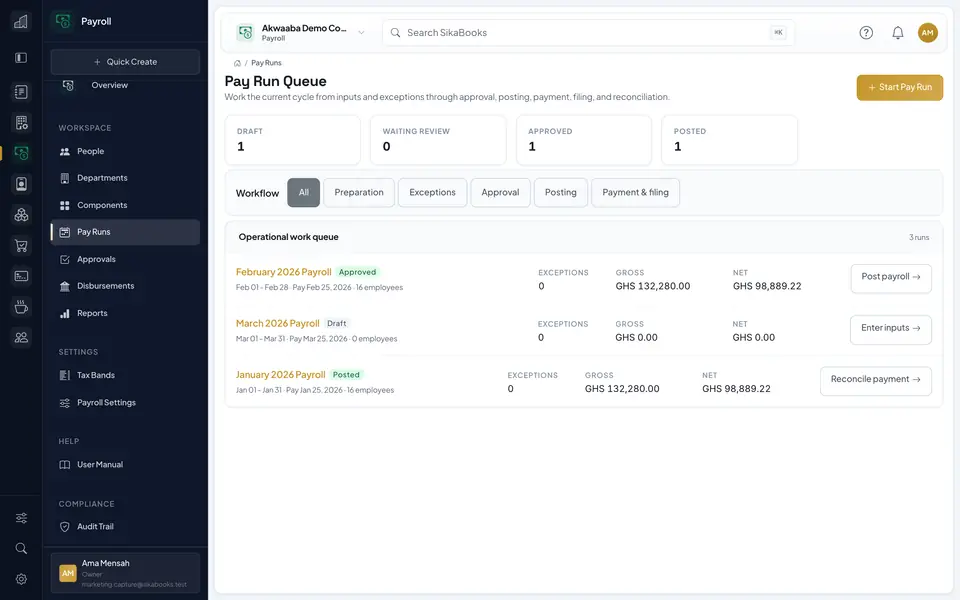
sikabooks Payroll includes the official schedule as "GRA PAYE Resident - Act 1178 (2026)", effective from 1 September 2026. New Payroll businesses receive it automatically. Existing businesses keep their configured table until an authorized settings manager reviews the bands and affected runs in Payroll Settings > Tax Bands > Review 2026 PAYE update and records adoption. A time-limited reviewed alternative requires an advice reference and expiry date; recording it is not a determination of legal compliance.
Recalculate open runs after the review. Posted payslips and journals stay unchanged; any statutory adjustment needs the controlled correction process. For transitional payroll, record the PAYE rule date basis and review reason. Each calculated run stores its rule date and schedule evidence. Payroll then supports approval, payslip emails, payment-file preparation for MTN MoMo, Telecel Cash and AirtelTigo, and PAYE Return and SSNIT Schedule exports using the business's configured statutory settings.
sikabooks prepares the figures and files; your business still submits the return through GRA's channels, pays on time and keeps the evidence. The Payroll guide walks through pay runs and statutory reports.
See current Payroll pricing and the Payroll workflow, or start your free 30-day trial.
Sources checked on 5 October 2026. This article summarises published guidance, not individual tax advice; check your own circumstances with your accountant.